Problem
Why build a workstation instead of a model script?
Production work may require high-similarity cloning, explicit emotion, text-designed voices, multiple speakers, and stable long-form output in the same project. No single model dominates every goal, so the application defines a shared generation contract and isolates engine differences behind adapters.
The visible flow is simple: choose a voice, select a model, enter text, and generate. Internally, the application handles reference preprocessing, voice-condition caching, isolated parameter profiles, lazy model loading, safe chunking, job control, audio joining, and output checks.
Architecture
A five-layer call chain separates the UI from model implementations.
Each backend keeps its own parameter profile. Switching restores only that model's settings and hides irrelevant controls. Leaving the native VoiceStudio backend releases its worker to control unified-memory use.
Model routing
Start with the desired output, then choose the engine.
| Goal | Preferred path | Prerequisite | Boundary |
|---|---|---|---|
| Stable Chinese cloning and long form | IndexTTS 2.5 | Reference audio or a 2.5 voice cache | Language-aware safe segment caps and guarded retries |
| Eight explicit emotions | IndexTTS 2.0 | Reference, emotion type, intensity | 2.0 and 2.5 voice caches are not interchangeable |
| Text-designed voice or whisper | OmniVoice | Design prompt; clone mode needs aligned reference text | Named emotions are approximations, not native vectors |
| Multi-speaker and inline expression | Fish Audio S2 Pro | Reference or automatic mode | Weights require separate commercial licensing |
| Native-runtime compatibility | VoiceStudio · OmniVoice | Local source, weights, isolated worker | MPS speech model with CPU audio tokenizer |
Invocation
CLI, Python, and a local OpenAI-compatible API are available.
IndexTTS 2.0 CLI
uv run mlx-indextts generate \
  -m models/mlx-IndexTTS-2 \
  -r reference.wav \
  -t "Today is a great day." \
  -o output.wav \
  --emotion happy --emo-alpha 0.6
IndexTTS 2.5 Python
from mlx_indextts.generate_v25 import IndexTTSv25

tts = IndexTTSv25("models/mlx-IndexTTS-2.5-int8")
tts.generate(
    text="Text to synthesize",
    reference_audio="voice_reference.wav",
    output_path="result.wav",
    seed=42,
    diffusion_steps=25,
)
VoiceStudio local OpenAI-compatible endpoint
curl -s http://localhost:3900/v1/audio/speech \
  -H "Content-Type: application/json" \
  -d '{"model":"tts-1","voice":"VOICE_PROFILE_ID","input":"Text to synthesize","response_format":"wav"}' \
  --output speech.wav
All examples execute locally. The production workstation adds chunking, progress, pause/cancel controls, partial saves, and quality checks around the raw model call.
Cloning workflow
The exact order of a complete voice-cloning job.
- Confirm rights: verify authorization for the reference voice and intended output.
- Prepare the reference: use a clear 5–15 second single-speaker clip without music or long silence.
- Route the request: choose by similarity, emotion, long-form, multi-role, or voice-design requirements.
- Build conditioning: IndexTTS creates speaker context; OmniVoice pairs audio tokens with an exact transcript.
- Chunk safely: split at natural pauses and within the active model's tested limits.
- Generate and checkpoint: write partial output per segment so cancellation preserves completed audio.
- Join and validate: connect segments with silence or crossfade, then inspect peaks, truncation, duration, and playability.
Engineering challenges
The product value lives in edge handling around the models.
Reference audio must match its transcript
Stable OmniVoice cloning depends on aligned audio and text. When the user leaves the transcript blank, the application runs local Qwen3-ASR on the exact preprocessed prompt audio and binds the result to that voice cache.
Long-form generation must be recoverable
IndexTTS 2.5 uses different safe limits for CJK and Latin text and retries suspiciously long segments after splitting. Fish S2 Pro uses punctuation-first chunks of up to 60 characters and writes a .partial.wav after every segment.
Approximation must not be described as native capability
IndexTTS 2.0 exposes native emotion vectors. OmniVoice's calm, happy, sad, energetic, and serious presets combine supported pitch, speed, and sampling controls; whisper is a native instruction.
Interface and audio evidence
See the running workstation from voice management to a playable output.
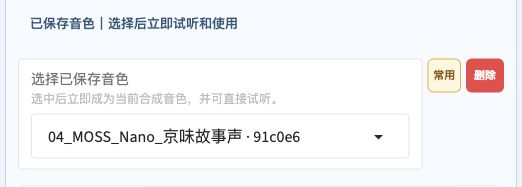
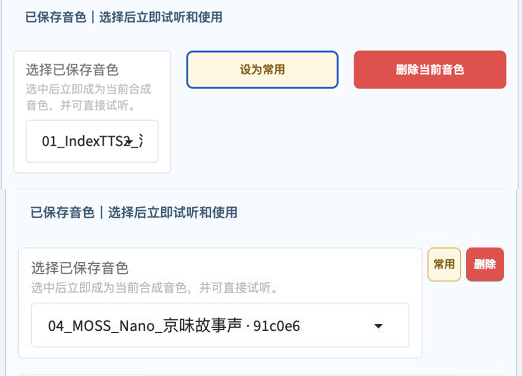
These interface records come from the actual IndexTTS2 2.5 production workstation and its browser validation. A voice is treated as reusable production data, not as a one-time upload.
Local IndexTTS2 speech sample
A 5.3-second sample that verifies web playback, media delivery, and machine-readable discovery. Production audio is created separately for each authorized voice, language, and target style.
Results and validation
Claims are tied to reproducible records.
- IndexTTS 2.5 and 2.0 build reusable voice conditions; 2.0 additionally exposes eight emotions and strength.
- Both MLX OmniVoice and native VoiceStudio OmniVoice support cloning, text-designed voices, and automatic voices.
- In the v0.4.1 local record, a 27-Chinese-character OmniVoice calm preset took about 6.6 seconds and passed the audio-quality check.
- Validation covers backend switching, parameter restore, long-form progress, pause/cancel, partial preservation, and output formats.
Similarity varies with reference quality, accent, language, and sampling settings. Commercial work must verify both voice authorization and each model-weight license.
Deliverables
Engagements can deliver finished content or the production system.
- Finished media: authorized voice clones, one-off or batch narration, long-form audio, expression variants, and exports.
- Tooling: local WebUI, voice library, model switching, queues, batch generation, and validation.
- Workflow integration: connect scripts, TTS, images, captions, video generation, and publishing preparation.
- Technical support: model selection, Apple Silicon adaptation, performance diagnosis, retries, and operator training.
Large projects: one WebUI task is protected at 100,000 characters. Projects of 100,000, 200,000, or more characters use chapter batches, model-safe segments, checkpoints, and narrow retries, with no fixed business-level project ceiling.
Source status
Compiled from the local README, v0.4.1 changelog, generation adapters, and design-validation record. Last verified: .